A brief background into Business Cards.

Business cards originated as trade cards in 17th century England. They were used both as advertising and as maps as there was no formal street numbering system in London at the time.

By the 1870s the trade card’s popularity had made it one of the most widespread advertising formats promoting everything from baby milk to pianos to patent medicines. They were displayed in offices, general stores, hotels, railroad stations, and restaurants, and salesmen assisted store owners in arranging advertisements for store counters and window displays using trade cards as well as larger formatted show cards.

The front of the trade card consisted of the business’s name or sometimes the name of one of the business’s products with a visually compelling illustration or design to attract the customer, while the back of the card was packed with details about the business statistics, product benefits, ordering details, the company’s location and contact information or anything that might interest the customer and enable him to buy the product or use their services.

Today business cards are still used as advertising as well as a convenient way to present a business’s contact information. Business cards can even double as brochures, for instance. Business cards are traditionally the primary way that business people present their contact information to other business people and potential customers or clients. Even though we are still in the digital age business cards are still thriving. Business cards provide a more tangible way to impart information about who you are and what you do, making them one of the most effective direct marketing tools. Having your business card ready to present to others when needed demonstrates a higher level of professionalism.

Standard business cards are around 55 x 84 mm rectangles of card stock, although now people have experimented with creative custom card designs have been done using a variety of materials such as wood, plastic, metal, and cloth.

As per the above example, the front of a business card normally has:

  • The business logo (can be anywhere on the card) and the name of the business
  • The slogan or an indication of the services or products supplied by the business
  • the business person’s name in the center of the card, followed by any degrees, diplomas or professional business designations in abbreviated format. Below the name is the title, e.g. director, manager, etc.
  • the business address, phone number(s), fax number(if applicable), and email address(es) normally reside on the lower left or right
  • the website URL (should be prominent if the business is primarily web-based, otherwise can be included in the address block)

The back of business cards is usually (but not always) blank. For instance, if you’re travelling abroad for business, it is good practice to have one side of your business cards translated into the language appropriate to the country you are visiting. just note the when you present such business cards, you should present the card to the recipient so that the recipient’s language is face up.

Covering letter.

Covering Letter

Here is my first attempt of a covering letter which I sent out to companies only to realise it was a massive fail with punctuation. How I could of prevented this was sending it to the tutors to read over for feedback as punctuation isn’t my strong point

Upon reflection I have now corrected the previous email and set up a covering letter template for future use. The structure is less less repetitive and grammarly correct now.

See stationery for final design…

Printing Techniques.

Offset lithography is the standard printing method used to produce paper based publications and documents; including many examples provided below from the book (Typography – Ambrose/Harris) However, other printing techniques exist for getting ink – and the design onto substrate.

Each of the techniques above imparts qualities into a design that are far beyond simply putting ink onto a page. Differences in the pressure used to apply the ink for example, can add individually, uniqueness or tactically to a design. These examples of letter press printing demonstrate how unique impressions can be created due to variations in the ink transfer from letters to substrate.

hot metal printing

hot metal printing or cast metal composition was developed from letterpress printing and originally involved the casting of lines of type on molten metal. This made it possible to create large quantities of type in a relatively inexpensive fashion. \Nowadays text is typed into a machine to produce a punch sort of paper tape, which then controls the characters cast by a machine. The resulting block – with its raised letters and fine detail can then be used to print from. The impression made, unlike lithography has texture and depth.

Silk Screen Printing.

Silk screen printing finishing forces ink through a stencil, pattern or template that has been produced on silk and stretched across a frame. The primary advantage of this printing method is that it can be used across a wide range of substrates, particularly those that are unsuited to other printed methods.

Gravure Printing.

Gravure or rotogravure printing is high volume intaglio print process in which the printing are is etched into the printing plate ink is then transferred from the plate to the substrate.

Print finishing.

A variety of print finishing techniques can be used to enhance the appearance of typography .. For example, the prominence of type can be increased with the use of screen printing or coloured varnishes. Similarly the use of blind embossing, flocking or spot varnish will render typography in a more subtle light. Basically, having an understanding of print finishing can make a difference between an ordinary and an exceptional piece of work. The execution of a final design is not only enhanced by bring finishing techniques, but it is inseparable from the process.

Embossing a debossing

Both of these techniques are used to produce different visual and tactile qualities to a design. particularly to the covers of reports, books, invitations, or other identity items.

Foil Blocking

Foil blocking is a finishing technique that applies coloured foil to a substrate via heat transfer (I have used this technique before when designing the brochure for Uniplay, it entails creating another file to overlay onto of your original design of which part you want to foil block) its typically used to provide a metallic look to the selected area.

Varnishes.

Varnish is a liquid shellac or plastic coating added to a printed piece after the final ink pass in order to enhance its appearance, texture or durability by sealing the surface. It may add a glossy, satin or dull finish and it can also be tinted to add colour. Varnish can be applied either as a spot varnish or a fully covering piece.

Inspiration.

My inspiration mainly comes from life experiences from travelling, mountain biking, hiking and surfing. i can’t get enough of the outdoors maybe its a way of getting away from the computer for a while… my whole aesthetic that is going to be set for my brand is based on the ‘hipster’ /’surf’ style or trend. As a designer, I never really know when inspiration will strike.  Although I might feel inspired while working, while taking a break that I find myself inspired. I think this is because during off times, my mind is free to process my experiences and to come up with new ideas.  As a result, I often feel inspired by hiking, mountain biking, surfing and travelling. Without my design inspirations, I often don’t add fuel to my creative fire.  This often results in an absolute blag! or the correct term ‘creative block’.  It is therefore very important that I surround myself with any artistic inspiration or even life experience in order to feed my imagination. Inspiration gives me the energy to create new designs and to work hard to ensure they fit with my image or vision.  It is when i am inspired that i produce my best work.  Inspiration assists me with brainstorming, mapping out new ideas and with bringing those new ideas to life. As a designer, inspiration assists me with keeping my creativity alive.  When i am innovative, I’m able to produce ideas that have never been seen before.  It is my creativity which produces ideas which are ‘fresh’, ‘new’, out of the box or even genius.

Alchemist (thealchemist.uk.com)

Designed by Fitzpatrick Maloney, The Alchemist brand represents the hipster/alternative trend that is now becoming the norm. especially the use of geometric shapes. Geometric come from geometry which is the math of shapes made of points and lines. Geometric shapes are shapes made out of points and lines including the triangle, square, and circle. Other shapes are so complex that it takes math in order to create them. These shapes are the opposite of organic shapes. While geometric shapes are more precise, organic shapes are natural. In this lesson, we will take a look at geometric shapes.

Royal Blood

Albert schloss

Tobias Hall

Northwest barber co (www.northwestbarberco.com)

Business card finishing options.

  • Rounded Corners Adding round corners to a business card looks original and interesting and isn’t expensive. The process involves cutting the square edges of your business card into a smooth rounded curve.
  • Spot UV When you add a spot UV to a card you are adding a varnish to specific areas of the design, resulting in a contrast of textures and finishes, Looks Class!
  • Embossing and Debossing An embossed or debossed business card has a raised or depressed pattern applied to it, which is applied using a punch. A traditional printing technique which is having a bit of a renaissance as companies strive to stand out from the crowd.
  • Thermographic (Raised Print) The process involves applying a special coating to the ink, whilst it is wet, resulting in a raised-feel once printed onto a business card.
  • Gloss & Matt Lamination Laminated business cards are durable and feel good. To make an impact on a business some companies offer a super glossy lamination.
  • Foil Blocking Foil blocking is the process of adding a metallic shape to any aspect of a business card design, this process can be especially powerful when used on a corporate logo.
  • Folded Business Cards These cards have a larger printable area (90mm x 120mm), the folded business cards are ideal for organisations with a lot of information to list, they are also handy to create appointment cards.

Paper Finishes

GSM and MIC (Micron) have no direct correlation. You can’t  just convert 1 into another. GSM is weight and micron is thickness.

  • 115gsm = 90 micron
  • 150gsm = 140 micron
  • 160gsm recycled = 180 micron
  • 235gsm (greetings card) = 355 micron
  • 300gsm = 290 micron
  • 300gsm recycled = 340 micron
  • 400gsm = 420 micron

Gloss Paper

Gloss papers give excellent colour reproduction and helps to lift high-quality colour images. The inevitable shine can make text-only items difficult to read when produced on gloss papers and when writing on a gloss sheet can be problematic (a ball-point pen will work, but many other types of pen won’t).

  • 130GSM
  • 170GSM
  • 250GSM
  • 300GSM
  • 350GSM

Silk Paper

Silk paper gives a high-quality colour reproduction without the shine of a gloss. The text is also considered easier to read than on gloss due to the lack of shine.

  • 130GSM
  • 170GSM
  • 250GSM
  • 300GSM
  • 350GSM
  • 400GSM

Bond Paper

Bond paper is a durable paper that is especially suitable for electronic printing and use in office machines including copiers and network and desktop printers. It is typically used for letterheads, stationery, business forms, and a variety of documents produced with inkjet and laser printers.

  • 100GSM
  • 110GSM
  • 120GSM
  • 170GSM
  • 380MIC

Kraft Paper

Kraft paper or kraft is paper or paperboard produced from chemical pulp produced in the kraft process. Sack kraft paper, or just sack paper, is a porous kraft paper with high elasticity and high tear resistance, designed for packaging products with high demands for strength and durability.

Note this paper would be ideal for the aesthetic of my brand

  • 195MIC
  • 457MIC
  • 400GSM

Curriculum Vitae Inspiration.

Vidar Olufsen

A combined resume and open job application formed as a humorous “Top Secret” report, giving away information about a creative designer definitely shows some creativity already and grabs the employees attention. This is a self promotion project that is made to display a variety of skills as a graphic designer and get attention from local design agencies. In today’s digital world, rather than just send a link to a web portfolio, People want to leave something tangible at the desk that would get noticed and leave a impact on the receivers face.

Sabraé Ragsdale

Another example of a “pack” containing all elements from a CV to a business card. The design itself shows the custom lettering and typography that Sabrae can do. This could be a possibility for me to show off my own typeface that I’m currently developing in Final Major Project.

Michelle Campbell

Michelle Campbell uses an infographic CV/resume differs from traditional CV/Resume in that it uses graphic design elements. Whereas a traditional resume will simply use basic text to list information from top-to-bottom, an infographic resume uses layout, colour, icons, and font styling to organise content. Personally id like to implement some of the infographic styles into my CV because it adds to a creative side more over just written and boring.

Kate Renner

The visual style itself of this CV captures my attention how it looks like its been printed badly or maybe worn a little. I think this style could be coherent with my stamp idea for a business card.

Matthew Lynch

Matthew has gone for a more simplistic and timeless branding based on clarity, consistency to create an identity which does not directly fit a design trend. Perfect design for starting out because you don’t quite know who you are as a designer.

Ashley Spencer

An example of a simple info-graphic resume, while at the same time keeping the design’s carbon footprint to a minimum. What fascinates me is to achieve this design he used no glue, and printed digitally on 100% post-consumer, recycled stock. Brilliant!

Nitesh Baviskar

In my opinion with this CV, the central layout is awful. Its the choice of paper that caught my eye. However I’ve looked into this style of kraft paper 195MIC in a solo press brochure and it can be expensive but it will be worth it.

Business Cards Book Research.

Business Cards 2: More Ways of Saying Hello

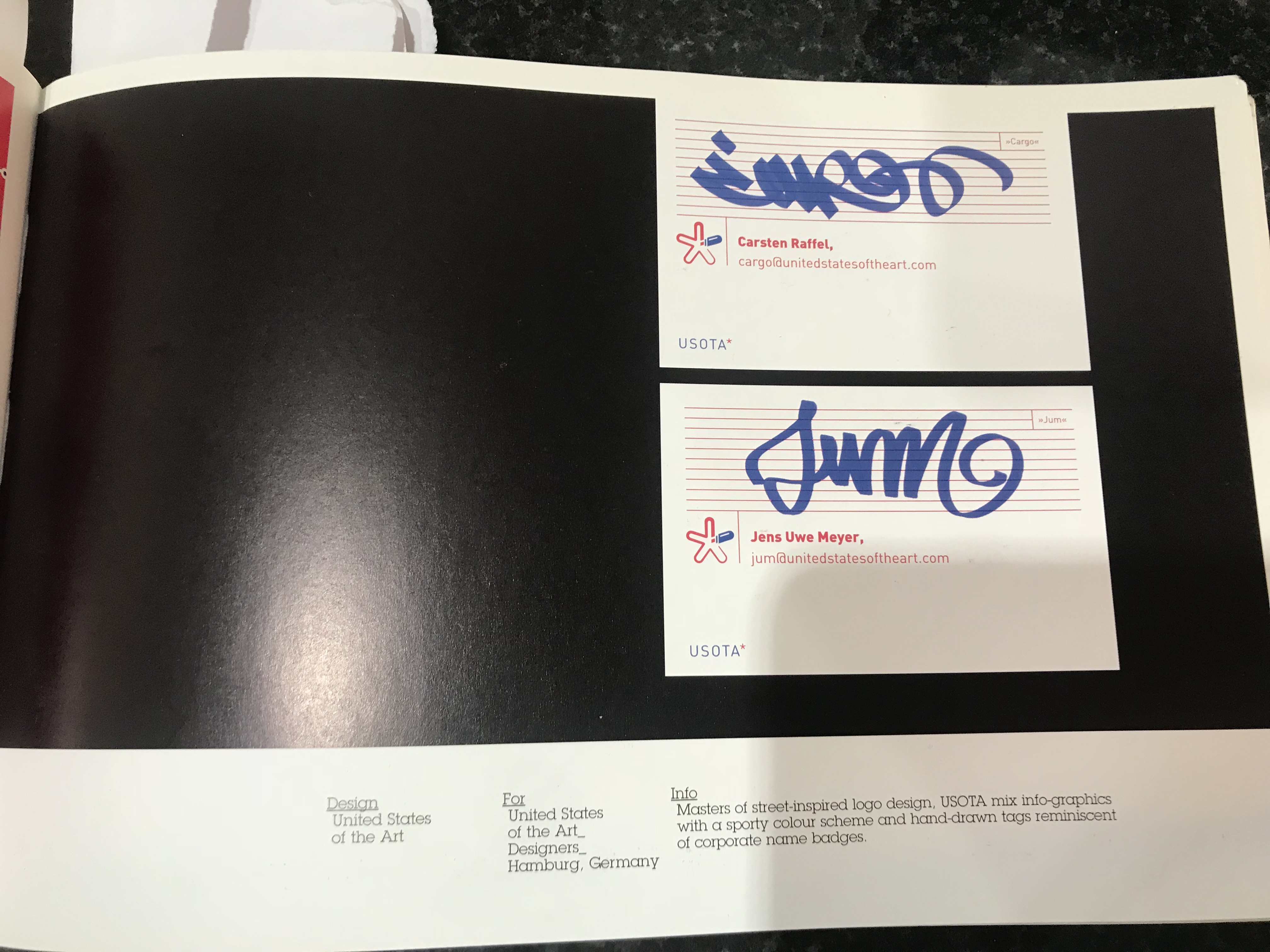
United States of the Art

The United States of the Art have mastered the street inspired logo with a mix of info-graphics with a sporty coloured scheme and hand drawn tags reminiscent of corporate name badges.

The design above with the latitude Location would be ideal for a design on my print because it would coincide with my brand/look. Also with my nature and passion for travel i could update my Latitude for my online profile as to what location I’m at.

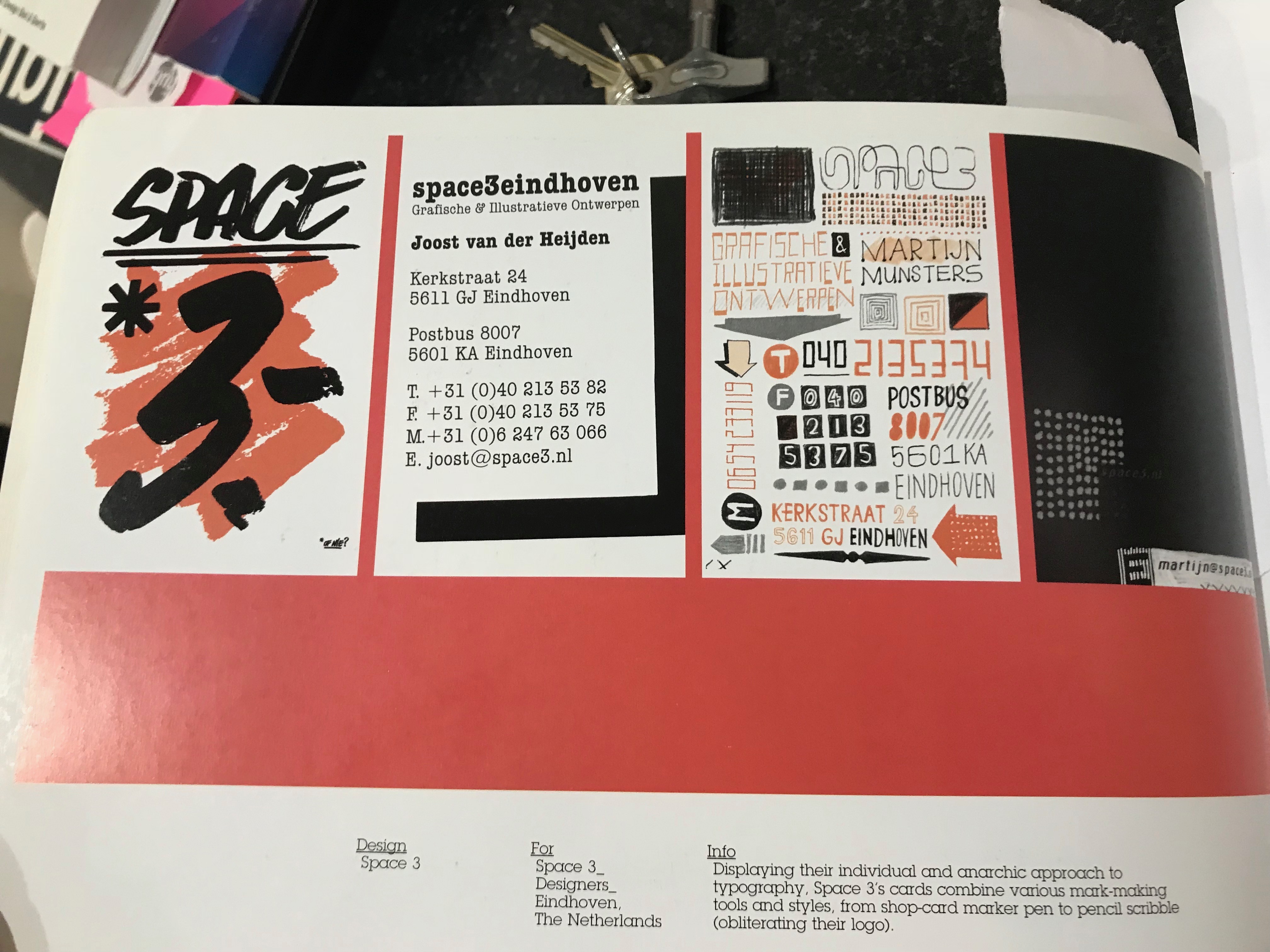
Space 3 for Space 3 Designers in Eindhoven pg 74

The Space three cards combine various mark-making tools and styles, from marker pen to pencil scribble completely obliterating their logo displaying their individual and anarchic approach to typography.

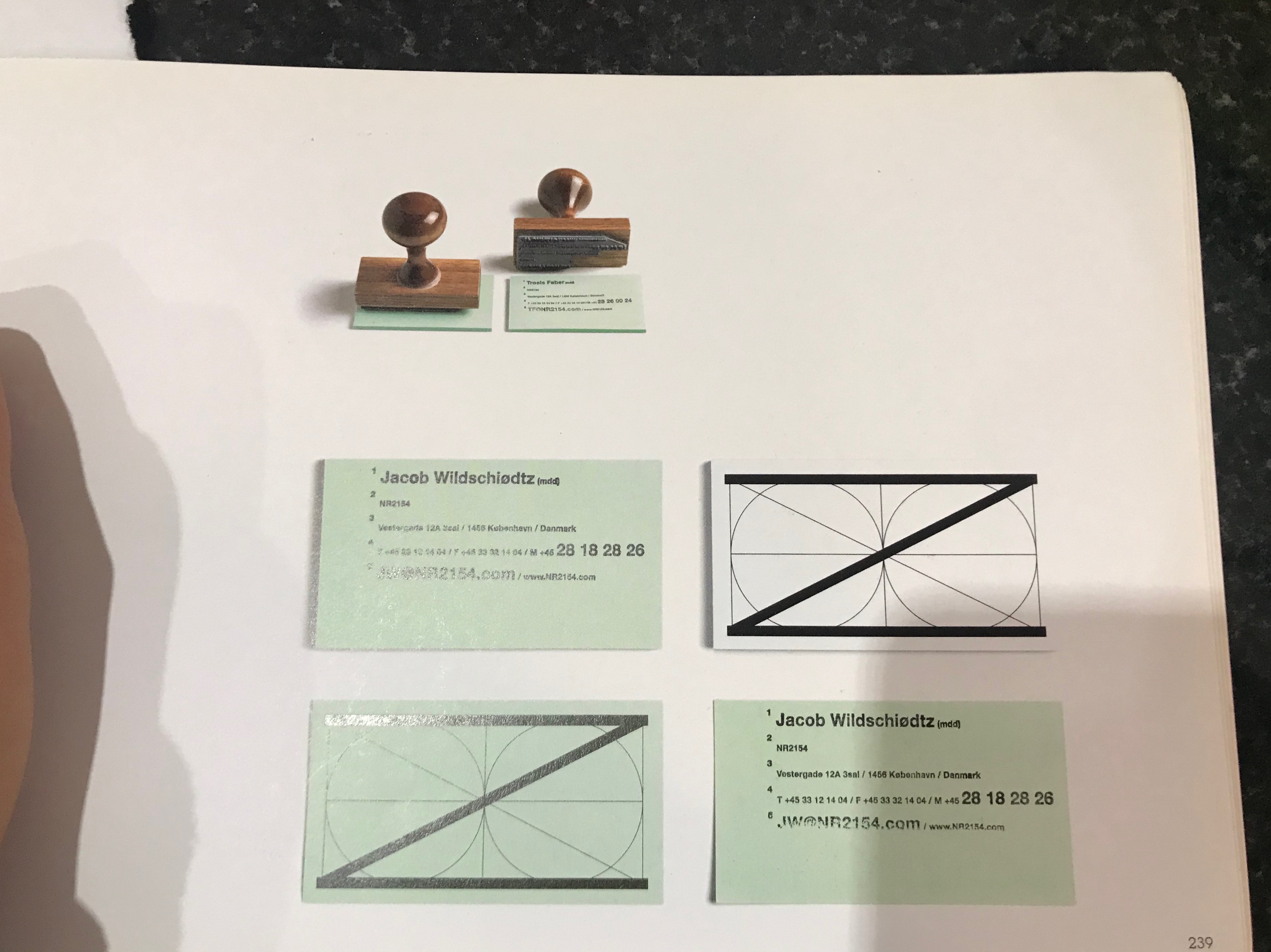
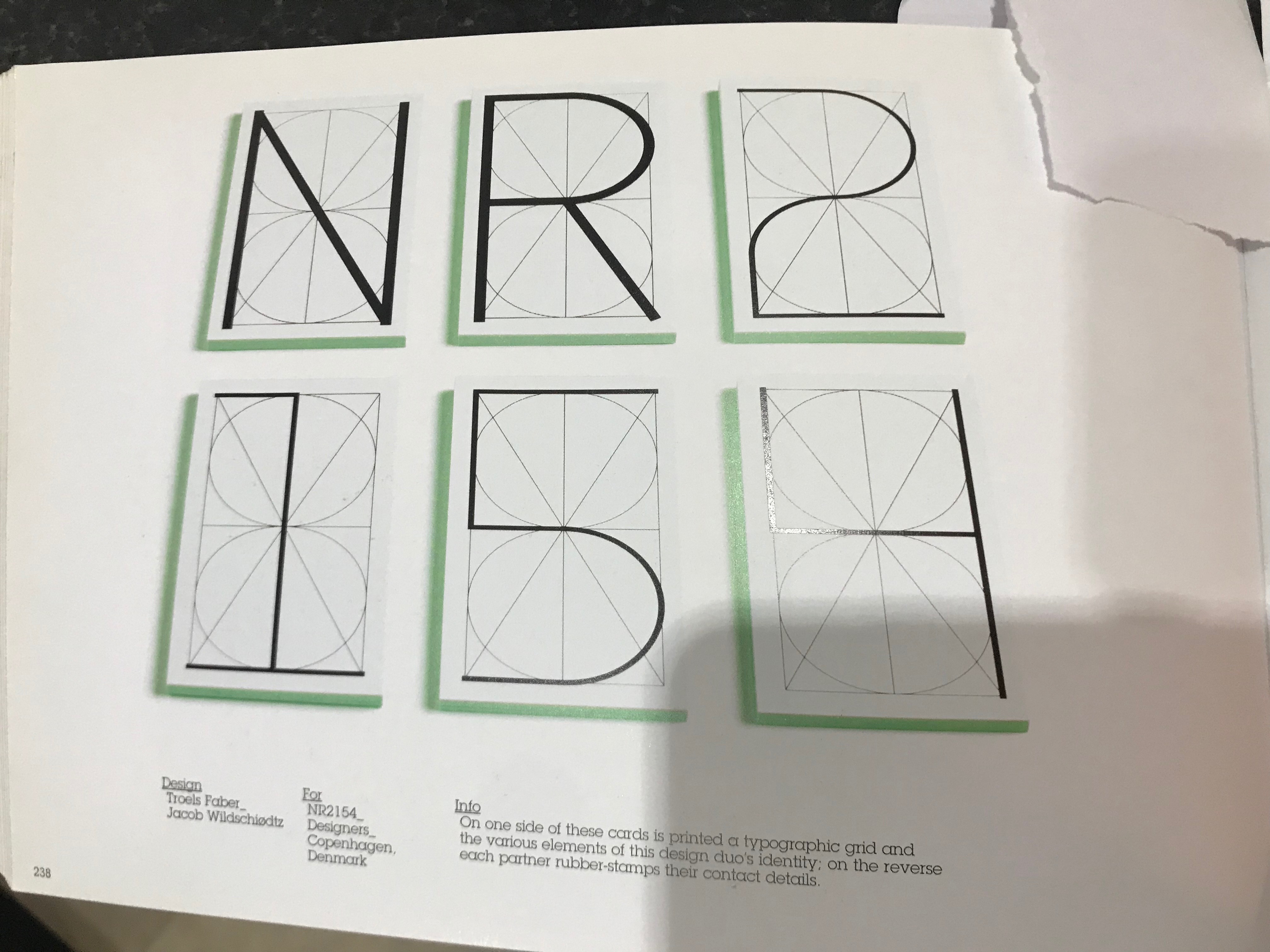
Troels Faber & Jacob Wildschioditz for NR2154 pg 239

On one side of these cards is printed a typographic grid and the various elements of this design duo’s identity; on the reverse each parter rubber stamps their contact details.

The card above is a massive influence for my design i intend to use a stamp but I’ve considered using different types of paper maybe even scrap paper and stamping my details onto it.

Fork Unstable Media

What Fork Unstable Media achieved, is a rigid grid over a lush organic illustration, an “abstract interpretation of the Garden of Eden complete with Adam and Eve.

Im mostly inspired by clean layouts but somehow i’ve picked up a need for randomness which is probably influenced by my lifestyle. The grid structure (although it looks messy) on these business cards catches my eye.

Jonty O’Connor
Jonty O’Connor
Jonty O’Connor

What i love about these designs is the useless printouts scraps of emails and mistakes even using leftover ink. RECYCLING! this has massively influenced me to use scrap pieces of paper and just stamp my details onto them.

Gareth Pugh – Fashion Designer

I think this is a fantastic idea very creative, Unique and affordable. They can be produced quickly using personalised packing tape and can be cut to any size whenever!

Tiller Williams

Using Stencil type to the best effect. this die cut card is understated and restrained, buttttttt oozes attitude! i had a die cut stencil in mind as a spray paint template but I’ve decided to go with the stamp on random paper as its more organic!

Business Cards Web Research.

Reasons to have business cards.

Marketing

A professionally printed card on quality paper lets people know you care about details. As a designer business card as a compact brochure advertising your business or your brand. An unusual design or dynamic logo can make your card stand out in a pile of cards.

Networking

Talking freelance terms business cards are a VIABLE!!! networking tool in a variety of situations. Networking is all about making initial contact with potential clients or people who can recommend your services to others and business cards provide an easy way to introduce yourself and your company. Keep a supply of cards with you in an attractive holder when you attend business events, such as trade shows and industry conventions.

Contact

You can make a great impression on someone in a face-to-face meeting, but you have to follow it up with contact information or it ends right there. Business cards can include more details than an email address or phone number, and handing someone a business card is faster than typing information into a digital device, allowing more time for conversation. Your cards should include location information and phone numbers, but go beyond the basics to make your card more intriguing by adding web addresses for company social networking sites, such as Facebook and Twitter.

Convenience

Using smartphones won’t be everybody’s cup of tea there will be occasions when all you have time to do is introduce yourself and hand someone a business card. Not everyone relies on or is comfortable with smartphones/tablets etc, so business cards are an essential tool for letting people know how to contact you. Some people also appreciate more traditional forms of communication and expect to exchange business cards.

Inspiration for design.

This eco-friendly vibe kraft paper business card creates a retro feel that could be coherent with my designs/brand. Its Earth coloured design and textured paper perfectly communicates the idea of sustainability.

Another example of a retro, vintage style business card, reminiscent of the Wild West feel. This design uses a letterpress, to create a subtle and classic look, on one side and screen printing on the other is a sort of sanded down feel to create a worn look. This design could also be quite expensive for me starting out as a designer.

Carrying on the vintage feel this business card is very similar to some of my typography and lettering. It is an example of a unique letterpress design that brings a retro design to life using embossing and debossing.

This business card is an aesthetic that is reminiscent of early urban development with a crisp new presentation. As if the logo and business card had also been restored from it’s original state.

This blind business card style is uses retro designs but keeps the minimal/clean vibe by using white on white debossing.

This design goes completely against my style of artwork and branding but the idea of having a tangible business card that the client can interact with makes this card memorable.

A business card that inspires me to experiment with materials and use something other than card however, i think the card itself would be more suited for a textiles student. This detailed vintage style card uses letterpress on a 2ply Cotton stock with Cherry Wood backing.

These letterpress business cards are catching my eye for my personal card designs but i feel its not retro enough for me. The business card above combines black and metallic silver over a cream coloured paper. Using what’s called optical art which creates the illusion of movement and vibrating patterns, this design is sure to make it stand out from a pile of other ordinary business cards.


Career Plan / Who am i?

Who am i?

  • Billy Drinkwater
  • Live in the Ribble Valley
  • Graphic Design BA (Hons)
  • Adventurer and Outdoorsman
  • Branding, Typography and illustrations

Pros and Cons of me as a designer.

Pros

  • Organising and planning
  • Software Skills from all Adobe to CAD
  • Time management
  • Meeting deadlines
  • Communication

Cons

  • Presentations
  • Working with others
  • Perfectionist (Could also be a pro)

Personal Bio

Billy Drinkwater is a Graphic Designer  with a print driven focus on brand identities, editorial design and Lettering. While very diverse, his aesthetic approach often merges minimalism with a distinct sense of travel. He specialises in helping individuals and companies increase target-market visibility by creating eye-catching artwork and he is committed to staying current with trending design and constantly challenges himself to learn more.

After my studies there will be thousand options to lead my life. I have already started researching into choosing the right path for myself but i live a very casual lifestyle and don’t really plan but just do. As long as i am happy about it, its fine! What i need to work on is preparing well for interviews and i know hard work does really matter in finding a best job.

3-6 months.

Scenario A.

In the first 6 months after Graduating i would like to see more of the world, meet new people and experience different cultures as back-packing can make me a much more interesting job candidate and it can make me more employable in the long run. Taking time out to travel will demonstrate maturity, good organisation, planning skills and self-sufficiency. Working while travelling can boost my curriculum vitae also it will help me with life experience and making future career decisions.

Scenario B.

In the first 6 months providing a find the right job for me, is to continue to learn and grow as a designer absorbing as much as possible from those with more experience than me will also help immensely at my young and impressionable stage. I will be as exposed and connected to inspiring individuals doing things that I would love to explore.

6-12 months

So after 6 months of my career, where I have all the inner workings of whichever agency I end up at. I would like the flexibility and responsibility of taking on projects on my own as well as taking on bigger projects and collaborating with other individuals/freelancers or agencies/studios.

Beyond 12 months

Beyond 12 months is really a mystery to me, will I be at the same agency? will I be travelling? will I have bought a house? I honestly can’t answer that… but speaking design terms I will be continuously learning and I hope to produce a lot more freelance work and do a lot more collaborations possibly start up my own agency? am I being to ambitious… NAHHHH! ill go for it!!!

Long Term Goals

Long term goals is the same as my 12 month goals… who knows? as long as I have something to keep me interested and busy job wise although if I am working for an agency I will not settle less than creative director or something with a job title along them lines. Not to blow my own trumpet, but I believe I have the work ethic, creativeness and passion/drive to do this on my own without relying on other people, I’m constantly trying to learn and better myself as a designer in and outside of work/university…THIS IS WHAT I AM SUPPOSED TO DO after years of getting that so wrong!!!

Thinking about myself.

The two main questions I have to ask myself is;

What do I want from my career? (what would give me job satisfaction?)

What do I have to offer employers? (what am I good at?)

Understanding my personality, and its effect on my behaviour and interests, can help in choosing a career. The Myers Briggs Type Indicator (MBTI) is an assessment tool that is widely used in personal development and career planning. The MBTI looks at my preferred ways of interacting with others, taking in information, making decisions and working.

ENTREPRENEUR PERSONALITY (ESTP, -A/-T)

Life is either a daring adventure or nothing at all.

Entrepreneurs always have an impact on their immediate surroundings – the best way to spot them at a party is to look for the whirling eddy of people flitting about them as they move from group to group. Laughing and entertaining with a blunt and earthy humor, Entrepreneur personalities love to be the center of attention. If an audience member is asked to come on stage, Entrepreneurs volunteer – or volunteer a shy friend.

Theory, abstract concepts and plodding discussions about global issues and their implications don’t keep Entrepreneurs interested for long. Entrepreneurs keep their conversation energetic, with a good dose of intelligence, but they like to talk about what is – or better yet, to just go out and do it. Entrepreneurs leap before they look, fixing their mistakes as they go, rather than sitting idle, preparing contingencies and escape clauses.

Never Confuse Movement With Action

Entrepreneurs are the likeliest personality type to make a lifestyle of risky behavior. They live in the moment and dive into the action – they are the eye of the storm. People with the Entrepreneur personality type enjoy drama, passion, and pleasure, not for emotional thrills, but because it’s so stimulating to their logical minds. They are forced to make critical decisions based on factual, immediate reality in a process of rapid-fire rational stimulus response.

This makes school and other highly organized environments a challenge for Entrepreneurs. It certainly isn’t because they aren’t smart, and they can do well, but the regimented, lecturing approach of formal education is just so far from the hands-on learning that Entrepreneurs enjoy. It takes a great deal of maturity to see this process as a necessary means to an end, something that creates more exciting opportunities.

Also challenging is that to Entrepreneurs, it makes more sense to use their own moral compass than someone else’s. Rules were made to be broken. This is a sentiment few high school instructors or corporate supervisors are likely to share, and can earn Entrepreneur personalities a certain reputation. But if they minimize the trouble-making, harness their energy, and focus through the boring stuff, Entrepreneurs are a force to be reckoned with.

Most People Don’t Listen Well Enough

With perhaps the most perceptive, unfiltered view of any type, Entrepreneurs have a unique skill in noticing small changes. Whether a shift in facial expression, a new clothing style, or a broken habit, people with this personality type pick up on hidden thoughts and motives where most types would be lucky to pick up anything specific at all. Entrepreneurs use these observations immediately, calling out the change and asking questions, often with little regard for sensitivity. Entrepreneurs should remember that not everyone wants their secrets and decisions broadcast.Sometimes Entrepreneurs’ instantaneous observation and action is just what’s required, as in some corporate environments, and especially in emergencies.

If Entrepreneurs aren’t careful though, they may get too caught in the moment, take things too far, and run roughshod over more sensitive people, or forget to take care of their own health and safety. Making up only four percent of the population, there are just enough Entrepreneurs out there to keep things spicy and competitive, and not so many as to cause a systemic risk.

Entrepreneurs are full of passion and energy, complemented by a rational, if sometimes distracted, mind. Inspiring, convincing and colorful, they are natural group leaders, pulling everyone along the path less traveled, bringing life and excitement everywhere they go. Putting these qualities to a constructive and rewarding end is Entrepreneurs’ true challenge.